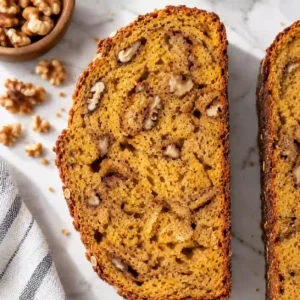
Sweet Sourdough Pumpkin Bread With Cinnamon and Pecans
Sweet Sourdough Pumpkin Bread combines active starter with roasted pumpkin and maple syrup.A cinnamon, brown sugar, pumpkin, and pecan filling adds warm autumn flavor.The loaf is cold-proofed overnight and baked in a Dutch oven until deeply golden.
Ingredients
For the dough:
- 100 g active sourdough starter fed and bubbly
- 200 g roasted pumpkin
- 500 g white bread flour
- 180 g warm water
- 30 g maple syrup
- 10 g salt
- Pinch of turmeric
- Pinch of cinnamon
For the filling:
- 50 g roasted pumpkin
- 100 g brown sugar
- 1 teaspoon cinnamon
- 15 g flour
- Pinch of nutmeg
- 60 g crushed pecans
Instructions
- Start the sourdough process in the morning, preferably before 9 a.m. Fermentation time will vary depending on room temperature and starter activity.
- In a large bowl, combine the active sourdough starter, 200 g roasted pumpkin, bread flour, warm water, maple syrup, turmeric, and cinnamon.
- Knead until the ingredients come together into a uniform dough ball.
- Cover and allow the dough to rest for 45 minutes.
- Wet your hands and lightly mist the dough with water. Sprinkle the salt over the dough and knead until incorporated. Rest for another 30 minutes.
- Lightly mist a clean countertop with water. Wet your hands, turn the dough onto the counter, and gently stretch the top over the bottom, then fold each side inward and the bottom over the top.
- Return the dough to the clean, damp bowl seam-side down and rest for 30 minutes.
- Meanwhile, prepare the filling by combining 50 g roasted pumpkin, brown sugar, cinnamon, flour, nutmeg, and crushed pecans.
- Turn the dough onto a lightly dampened countertop and gently stretch it into a rectangle without tearing it.
- Spread the pumpkin pecan filling evenly over the dough.
- Fold the dough over the filling from the top, bottom, and sides. Gently knead until the filling and pecans are distributed throughout. The dough may become sticky, so use a bench scraper as needed.
- Perform another gentle stretch and fold. Return the dough seam-side down to the bowl and rest for 1–2 hours.
- Perform the next stretch and fold, return the dough to the bowl, and rest for approximately 2 hours.
- Complete one final stretch and fold. Return the dough to the bowl and allow it to rest for another 1–2 hours. Watch the dough rather than relying only on the clock, since Sweet Sourdough Pumpkin Bread can ferment faster in a warm kitchen.
- Lightly flour a clean countertop and your hands. Turn the dough onto the counter seam-side up.
- Pre-shape by gently stretching the dough and folding the sides inward, followed by the top and bottom. Turn it seam-side down and gently tuck the edges underneath to create a round shape.
- Dust with flour, cover with a clean tea towel, and rest for 1 hour.
- Lightly flour the dough and counter again. Flip the dough seam-side up and repeat the folding process.
- Turn the dough seam-side down and carefully create a tight, round final shape.
- Generously flour a proofing basket. Alternatively, use a bowl lined with a well-floured clean towel.
- Transfer the shaped loaf to the basket with the smooth side facing down and seam facing up.
- Cover and refrigerate for 8–12 hours.
- After the cold proof, preheat the oven and a covered Dutch oven to 450°F (232°C).
- Carefully remove the hot Dutch oven. Turn the chilled dough onto a large piece of parchment paper so the seam is underneath.
- Score the top with a sharp bread lame or knife.
- Use the parchment paper to carefully lower the loaf into the Dutch oven.
- Cover and bake at 450°F (232°C) for 35 minutes.
- Remove the lid and continue baking for another 20–30 minutes, or until the crust is deeply golden and the loaf is fully baked.
- Transfer the finished loaf to a cooling rack and cool for at least 1 hour before slicing.
Notes
Roasted pumpkin should be smooth and relatively thick. If your pumpkin puree contains a lot of excess water, drain it before weighing to prevent an overly wet dough.
Serve this sourdough pumpkin bread recipe slightly warm or toasted. It pairs beautifully with butter, maple butter, cream cheese, nut butter, or a light drizzle of maple syrup.
For extra texture, reserve a small amount of crushed pecans for serving. Walnuts are also a simple substitute if pecans are unavailable.